DAZ METHOD · Watering
Top Watering or Bottom Watering for Organic Cannabis Growing?
There are two ways to water a pot by hand: apply water to the surface of the growing medium, or add it beneath the pot and let the medium draw it up through capillary action. Each approach has advantages and drawbacks, and they require different preparation and watering practices.
Top Watering
Top watering is generally easier to put into practice. As you distribute water across the surface, it soaks into the growing medium and moves downward with gravity. This makes it easier to moisten the medium throughout the pot.
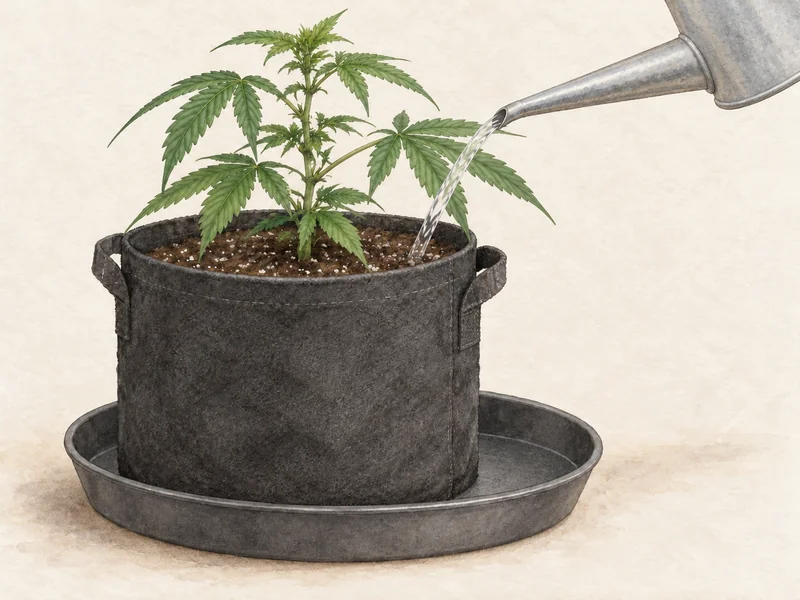
This approach also works well with top-dressed amendments. The water directly moistens the organic materials applied to the surface. That layer needs to stay moist enough for soil organisms to break those materials down and gradually release their nutrients.
With each watering, water can also carry fine particles into the growing medium and transport nutrients that are already dissolved. This helps move some of the added materials into the soil and distribute them toward areas occupied by roots.
The same advantage applies to products mixed into the water. They reach the surface of the growing medium directly and can move into it as the water soaks in. This is particularly useful with a powder such as AZOMITE, which does not dissolve completely.
However, you need to take the time to distribute the water evenly. Pouring too quickly can compact the growing medium and cause water to run off or drain out before the medium has had time to absorb it properly. A better approach is to water slowly across the entire surface, making several passes.
Personally, I work with three watering cans. I pour about 100–200 mL onto one pot, spreading the water across the surface, then move to the next. I keep returning to those same pots until the watering cans are empty, then move on to the next group of plants.
Bottom Watering
Bottom watering involves pouring water into a saucer and allowing the growing medium to draw it up through capillary action. You can also place several pots in a shared tray and water them together.
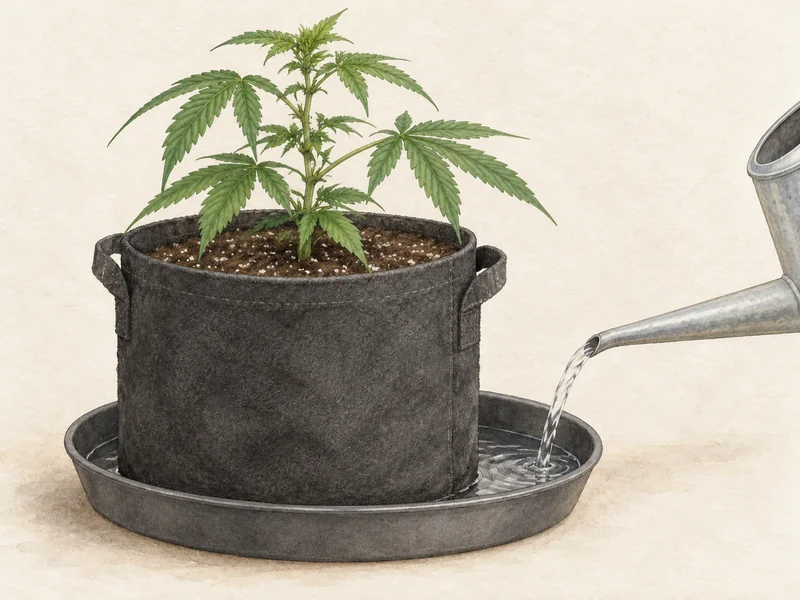
With a shared tray, you add the full amount of water intended for all the plants at once, then let the pots absorb it. This can save time because you do not need to make repeated passes over each pot. It also avoids the compaction and runoff that can result from pouring water too quickly onto the surface.
However, the pots may not absorb the water evenly. Some may take it up faster or absorb more than others. Their initial moisture levels are one factor: a growing medium that is still moist may rewet more easily than one that is drier.
If these differences keep recurring, some pots may stay too wet while others receive too little water. The plants then fall out of sync, making watering harder to manage.
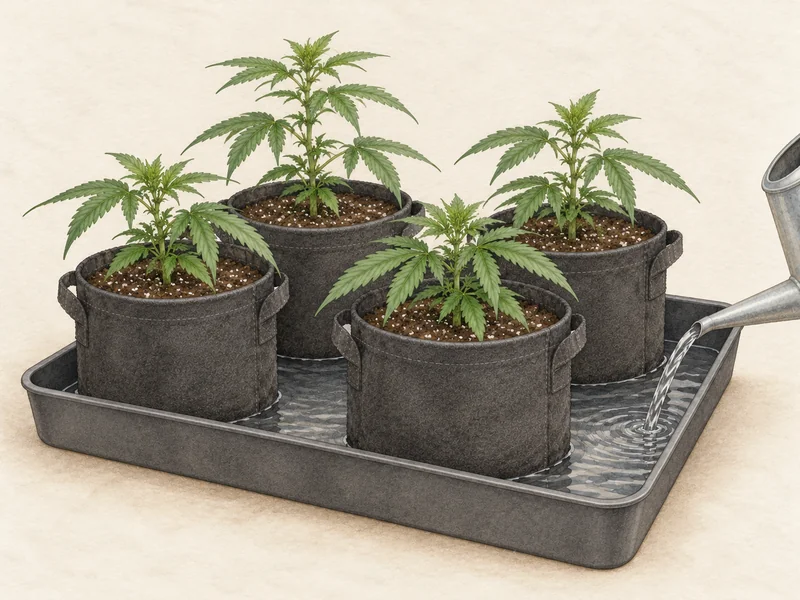
Individual saucers avoid this uneven sharing of water. Each pot has access to the amount intended for that plant and can absorb it at its own pace, without another pot taking some of its share.
Whether you use individual saucers or a shared tray, bottom watering requires a growing medium that can act as a wick. Water needs to move upward through capillary action and moisten the medium throughout the pot.
If that movement is insufficient, the lower half may stay very wet while the upper portion remains too dry. Roots then tend to grow mainly into the lower and middle portions, where conditions are more favorable.
This also creates a problem for top-dressed amendments. If the surface stays too dry, biological activity there slows considerably and may nearly stop. The organic materials undergo little or no breakdown, and the nutrients they contain are not released as expected for the plant.
I have observed this in other grows that used bottom watering. The growing medium did a poor job of distributing water through capillary action, and both moisture and roots were concentrated mainly in the lower half of the pots.
Midway through flowering, the pots were watered from the top to apply liquid products. The plants became noticeably greener afterward and then struggled to senesce.
That watering also rewetted the upper portion, which had previously been too dry, with little biological activity. Renewed biological activity can gradually make nutrients available again, while water moving downward carries some dissolved nutrients toward the roots. This can contribute to an additional nutrient supply at a stage when the plant no longer needs that much.
Finally, not every product mixed into irrigation water moves into the growing medium equally well with bottom watering. Dissolved nutrients move with the water, while suspended particles, such as those in AZOMITE, may settle in the saucer. Depending on the fabric and particle size, a fabric pot may also prevent some undissolved material from passing through.
Should You Make Roots Search for Water?
You often hear that you should keep the growing medium drier to encourage roots to search for water and spread throughout the pot. I wanted to test that idea myself.
At the time, I was applying an amount of water equal to about 10% of the pot’s volume at each watering. To test the idea, I reduced that to about 5% and watered more frequently. My aim was to keep the growing medium less moist while encouraging root development.
Those small, repeated waterings mainly kept the upper portion moist. Some areas near the bottom stayed too dry, and roots did not grow into them. By reducing the amount of water applied each time, I had mainly created an uneven distribution of moisture. Watering more often was not enough to correct it.
The same problem can occur with bottom watering when the growing medium does not distribute water adequately throughout the pot. Even if the planned amount of water is sufficient, that does not guarantee the upper portion will become moist if the medium does a poor job of moving water through capillary action.
In my trial, the bottom stayed too dry. In the bottom-watered grows I described, it was mainly the top. In both cases, the overly dry areas had little or no root growth.
Roots respond to water availability, but that does not mean a shortage of water will always encourage more root growth. They grow more readily into areas with a favorable balance of moisture and air. An overly dry part of the pot does not become more hospitable simply because we hope roots will search for water there.
That is the problem with the oversimplified advice to “make roots search for water.” It can reduce the volume of growing medium the roots actually use, even though the goal was to encourage them to spread through more of it.
The plant then makes less use of the space and resources available in the pot. Its development may be limited, with possible effects on yield and final quality.
Finding the Right Balance Throughout the Pot
Whichever method you choose, the goal is to maintain enough moisture and air throughout the pot to support root development and keep the living soil functioning.
Moisture does not need to be exactly the same everywhere in the pot. There can be a gradient between the top and bottom, as long as conditions remain favorable throughout the growing medium. What you want to avoid are areas that stay too dry, or too wet and poorly aerated, for extended periods.
This balance depends on the structure of the growing medium, how moist it is before watering, how much water you apply, and how often you water. Even a well-structured, free-draining medium can stay too wet if you apply too much water or water too frequently.
The two methods therefore call for different preparation and practices. Top watering is generally easier to put into practice and makes it easier to use top-dressed amendments or products mixed into the water. The main requirements are to distribute the water evenly and give the growing medium time to absorb it.
Bottom watering can reduce hands-on work and save time, especially when watering several pots, while avoiding the compaction associated with watering from above. The trade-off is that it requires a growing medium that distributes water effectively through capillary action and an approach to feeding the soil that works with this method.
Both approaches can work. In either case, the aim is to maintain favorable conditions for roots and soil life, all the way from the top of the pot to the bottom.
On Instagram, copy the link and add it to your story with a link sticker.
LET’S TALK ABOUT IT
And you, what do you think?
Do you agree, see it differently, or have an experience to share? Leave a comment: let’s compare observations and keep the discussion going.
The discussion